
 I consider this to be one of the greatest albums of all time. Not only for its excellent lyrics, its absolutely genius guitar solos by David Gilmour, but for the message it conveys. With many different themes involved, the whole album tells the story of "Pink" a rockstar trapped in a tortured and torturing world. Here is a presentation of the band, the album, the songs, and finally my synopsis about the movie released in 1982. This album and the movie are a must have!
If you have any suggestions about themes I might have missed, imagery I might have misinterpreted or if you just want to ask questions, you can comment freely at the end of the post.
SPOILER ALERT! YOU SHOULD NOT READ THE SYNOPSIS UNLESS YOU HAVE WATCHED THE MOVIE BEFORE.
Pink Floyd:
Pink Floyd is a British band formed
in 1965. Their success in the underground music scene led them to a
breakthrough, and a later worldwide success with over 200 million albums sold
all over the world. The former band was composed of Nick Mason, Roger
Waters, Richard Wright, Syd Barrett and David Gilmour.
Their conceptual albums are known for their intelligence and both their
philosophical and political messages.
The Album:
The
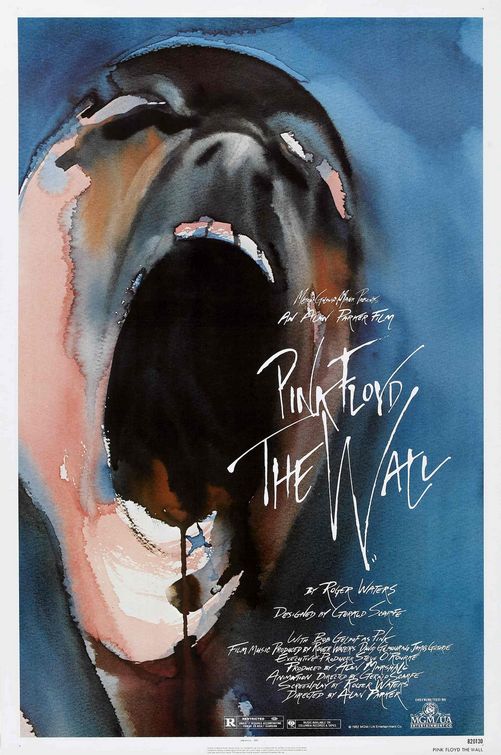
Wall is the ninth album by Pink Floyd. Released in 1979, this opera rock was to
be adapted in a TV series. This idea was dropped and the album remained as such
during three years where it became a worldwide bestseller. It is now in the top
five best selling albums in the USA,
and has acquired 23 times platinum album in the same country.
 The
Movie – General Information:
The
Movie – General Information:
Released in 1982, it was directed by
Alan Parker, also known for the movie “Midnight Express”. Written by Roger
Waters, the movie only focuses on the soundtrack of the album (only two songs
were deleted and one added). The protagonist is played by Bob Geldof, an Irish
songwriter who replaced Roger Waters in the leading role.
The
Plot:
Feeling his personality fading, Pink
protects himself behind a metaphorical Wall. This wall will soon push him to
madness, facilitated by his downfall in drugs. This personal insight shows him
all the important aspects of his life; his father’s death in the war, his
over-protective mother, his tortuous education, his destroyed marriage… as many
bricks in his wall (“Another Brick in the Wall”) and as many elements to fill
the “Empty Spaces”. This insight will lead him to his own “Trial”.
The
Songs:
- When the Tigers Broke Free: Description of the death of Pink’s father.
- In the Flesh? : Beginning of Pink’s narration of the construction of the Wall, invites the spectator to "claw his way through this disguise" (appearances vs. reality).
- The Thin Ice: Represents the fragile period of innocence in people's lives before they can really understand the world around them. Here shown by the realisation of his father’s death.
- Another Brick in the Wall 1: Beginning to build the Wall following the first tragedy of his life.
- Goodbye Blue Sky: Reference to the German bombings over UK during the WW2, illustrates the innocence of the child, strong anti-war message.
- The Happiest Days of Our Lives: Theme of education, not encouraging them to fulfil their dreams, pushing them down (Waters’ view of education).
- Another Brick in the Wall 2: Shows the forced blindness of the pupils who march in line to a meat-grinder and come out as clones, modelled to fulfil a defined task.
- Mother: Underlines a new aspect of the Wall, the over-protectiveness of his mother who has provided enough bricks to his Wall and has therefore condemned him to a destroyed marriage as he finds out his wife is cheating on him because of his lack of attention.
- What Shall We Do Now? (Empty Spaces): Important song. Both depict an image of his marriage and what is to be done after its failure (finish the Wall?). There is a hidden message at the beginning which can only be heard when played backwards. It says:
-Hello, Luka
[hunters]... Congratulations. You have just discovered the secret message.
Please send your answer to Old Pink, care of the Funny Farm, Chalfont...
-Roger!
Carolyne's on the phone!
-Okay.
It is believed this message is addressed to message hunters who can
send their answer to Syd Barrett (Old Pink) in a psychiatrist hospital (funny
farm).
- Young Lust: Desperation leads him to inviting a groupie in his apartment, this underlines the themes of adultery and that “love turns grey”.
- One of My Turns: Besides a vision of his relationship with his wife, we have a sudden outburst of violence as he destroys the room and scares the groupie away. This can be interpreted as a metaphor for fear-based explosions of anger at his wife.
- Don't Leave Me Now: His wife is imaged as a praying mantis-like monster, which then transforms into the vulva-shaped flower from "What Shall We Do Now?”. Pink is tortured by the adulterous behaviour of his wife.
- Another Brick in the Wall 3: Decision to finish his Wall; he dismisses all the people in his life as “bricks in the wall”.
- Goodbye Cruel World: This song marks his acknowledgement of his isolation from society.
- Is There Anybody Out There? : This song is a cry for help as Pink realises he has made a huge error cutting himself from society. The repetition of “Is there anybody out there” suggests there is no answer.
- Nobody Home: This song depicts the loneliness behind the wall, it has a general reference to all the band members who were involved in drugs or were crawling under the huge pressure of the tours.
- Vera: This song is a reference to the singer Vera Lynn, who during the World War sang “We’ll Meet Again”. With the quote “Vera, what has become of you”, Pink asks what is there to hope from war. He cannot perceive a truth behind the song as his father has died.
- Bring the Boys Back Home: Alone among the reunited families of the war, Pink expresses an idea of isolation.
- Comfortably Numb: A dialogue between Pink and the doctor who injects an antidote “that’ll keep you going through the show”. In his hallucination he goes through many of the multiplying aspects of his childhood (the death of the rat, his protective mother…). His body begins to decay only to reveal a fascist figure underneath.
- The Show Must Go On: The show can be a metaphor for life itself. He debates over his continuation in life.
- In the Flesh: The fascist Pink goes to the show which soon becomes a Nazi rally. His drug induced hallucinations lead him to banishing every social minority, only imaging his loneliness.
- Run Like Hell: Pink sends his Nazi followers to attack those he thinks "ought to be shot". We have an expression of his rage towards society and his disgust over everyone different from himself.
- Waiting for the Worms: The Worms is the name given to both the fascist movement and his crawling isolation as they “eat his brain”. This march-like song sends an idea of hatred as he shouts trough the megaphone invitations to join the movement.
- Stop: His cry for help is finally heard as he escapes his dictator position and yells out his distraught. The guard in the bathroom as he pushes the door opens Pink to the real world and to his judgement.
- The Trial: Pink leads himself to his own Trial as he tries to escape isolation. He goes through all the flaws of his life (the schoolmaster, his mother, his wife…). Being the only guilty ("...the way you made them suffer, your exquisite wife and mother...") he is sentenced “to be exposed before your peers...". The final verdict is to “Tear down the Wall” enabling him to come back to reality.
- Outside the Wall: The idea generalises to the whole world, as the film explains that everyone has his own little wall to control. If one does not tear down their own metaphorical wall those trying to get in will eventually give up and leave you to live out a lonely life. This is what happens to the main character, Pink, during the course of the album.
Synopsis:
Different
themes come out of this movie. We will consider each of them one by one and
gradually attempt to create a link between the album and their creator.
- War: This recurrent theme is illustrated from the very beginning through the ideas of death and destruction. This physical destruction shown in the first song “When the Tigers Broke Free” will henceforth lead to a moral destruction for Pink. This first aspect is a direct reference to Roger Waters whose father died in the Second World War. The political view associated with the destructiveness of the Nazi movement during the war in the songs “Goodbye Blue Sky” (The Blitz) and all the songs referring to the “Worms”, leaves a general feeling of hatred towards society and its blind involvement in such a terror.
- Appearances vs. Reality: This is surely the most important theme of all. Introduced by Pink’s exclamation “claw your way through this disguise”, it underlines a present duality in his personality, almost schizophrenic. We are asked to differentiate right from wrong, guilty from non-guilty, and real from imaginary. What appears to us as the effect of life’s cruelty on Pink may only be the consequences of what he did to himself. In the final phase of the album we are asked to follow a different perspective from the one imposed throughout the songs. We go from the character Pink and his psychological reaction to what was inflicted to him, to Pink and his INTERACTION with the outside world. We later understand that though some aspects are only the work of fate (father’s death), most aspects are the consequences of his actions, such as how he abandoned his mother or his wife. This brings an important message: we have to go beyond our own person and consider how each of our actions not only affect us (should it be directly or indirectly), but mostly the people around us.
- Social Isolation: The image of the Wall itself is the metaphorical representation of this entrapment. In the songs “Vera” and “Bring the Boys Back Home”, and after having completed his Wall, Pink’s isolation is enhanced through the comparison between his loneliness and the general reunion of all the other families. As he sinks deeper in his loneliness, he expresses his desire to reject anyone different from him by using the image of the Nazi movement rejecting the Jews and homosexuals, not only because of racism but also because of fear. The theme is closely linked to the use of drugs. As for the band members, Roger and David have explained it is a very recurrent state of mind during their tours. Roger Waters explained that the song “Comfortably Numb” refers to the time he was injected before going on stage to fight hepatitis during the 1977 tour. As for the song “Nobody Home”, it refers to the ex-band member Syd Barrett, whose condition during the 1967 tour was deeply influenced by drugs.
- Education: This theme closely linked to War, supports a base idea: Education is a creator of puppets (Pink is symbolized as a rag-doll in “The Trial”). Indeed Waters views education as the discouragement of life’s hopes. When Pink is mocked for his poetry writing in class to then carry on repeating his lesson like a robot, his imagination of a factory of pupils turns out to be very resembling.
- Adultery: Mainly used as a supplementary aspect of Pink’s life, this theme leads us to the idea of communication and therefore the lack of interaction he had with his wife.
No comments:
Post a Comment